If you’re an educator, there are two reasons to resent Plato.
First, he is said to have been the impetus for stranding Greece’s oral tradition of communication, left alone like a baggy old man in droopy shorts, waiting for crowds to gather for stories. Instead, Plato wrote books. No longer did his admirers have to stand on the same marble steps to hear him out. But writing books, even when hiring scribes, was onerous. After a number of centuries, the printing press popped up, the technology quickly excelled, and by the middle of the Industrial Age, information was spinning out of high-speed, steam-powered cylinder presses faster than modern threshing machines can separate the grains from the inedible. Books became commonplace and year after year, they were more and more poorly written. Instead of grains of wisdom from atop the gleaming hill of God, information in books mostly involved stalks and husks. Pulp. Apparently Plato didn’t see this coming.
Ubiquitous access to electricity and the invention of radio and television came a few decades later, which led to the literal lightning-speed transfer of interesting ideas and nonsense. But high-speed printing and TV were primitive and kind of cute compared to the speed at which information spread over the World Wide Web. Instantly, one could promote random acts of kindness or bait people into rage fits by pretending to care whether Michael Jackson was a disgrace or the brightest star in pop music. The Internet was integrated into our phones, homes, and businesses. Technology quickly advanced again, and smartphones were inserted underneath our skin and leeched into our bloodstreams. But the impact of Plato’s gall would deliver yet another way to communicate. While smartphones tethered us to the product by ensnaring our brain chemistry, artificial intelligence was stuffed down our throats and pressed into our gullets with a wooden pestle barely narrower than our mouths. Today, separating the wheat from the chafe is like reaching blindfolded into a bucket full of gum balls and trying to pick out only the orange ones. What would Camus say about this latest development in the propagation of ideas?
If Plato had listened to Socrates and used his guile to expand one’s use of oral skills instead of throwing the snowball down the mountain, I wouldn’t be standing at the head of a classroom full of children whose brain’s reward systems crack and fizzle from dopamine exhaustion. If they aren’t gritting their teeth to help them avert checking their notifications, they’re going to the bathroom for fifteen minutes to relieve their need to check them, and if neither of those tell-tale signs of addiction don’t show, it’s because they were on the device until three or four in the morning and simply cannot stay awake.
From writing, to printing, to electricity, to television, to the Internet, to Smartphones, to AI, Plato is culpable for the ultimate outcome of his decision to publish. I wonder if it occurred to him that standing in the presence of others for a nice discussion is not only the most natural and time-tested form of communication, but the most dignified?
Thanks, Plato.
The second reason educators might resent Plato is that he invented school, and the West has been trying to replicate it since. The institution worked for him and his students because they were the intellectual elite, intrinsically and pragmatically motivated to discuss the most complex ideas of their time. The material engaged the students and, known as a “school for would-be politicians,” it was directly relevant to their success and future. Plato presented open questions rather than directives, encouraging students to experiment with ideas. They role-played characters in his books. They examined ideas and contradictions to uncover deeper truths. These learning strategies are useful for any homogeneous classroom full of highly capable students.
But Plato’s students weren’t tethered to fentanyl- or alcohol-addicted parents and guardians, nor the daily belittling or neglect that often came with it. They didn’t walk into their school carrying the anvils of shame, inspired by physical and sexual abuse. They weren’t inundated with trending dance reels and unchecked visual access to oral and anal sex before and during their sexual development. They weren’t identified with learning disabilities, nor did they manage autism or ADHD. They weren’t stuffed into overcrowded yellow buses or brick buildings or small rooms. They weren’t facing firehoses of conflicting information coming from seven different directions, nor did they have rechargeable devices that erased memory, shortened attention span, and compromised one’s cognitive endurance.
To be fair, the young men invited to Plato’s Academy (or του Πλάτωνα ακαδημία) had their own host of problems, but they were the A-list learners in the company of some of the greatest minds in history, and their classroom was located in an olive-grove park. Ancient Greece is interesting in every way, but it has nothing to do with modern-day education or what our children need.
Thanks to you, Plato, tens of millions of school children are zip-tied to chairs. Their dopamine activity has run amok, their mental well-being compromised, and the long-standing challenge of surviving adolescence, students of every intellectual capacity . Ever since your success, nations have fashioned their schools after your Academy. They are being asked to have their minds enlightened in cold, hard buildings, and sometimes beige and white trailers that looks like a storage building for a semi-truck and tractor parts business. They get unforgiving seats on which state-mandated seat-time requires six hours a day, five days a week. For most of the last century or so, they had little to no say in who educates them, who they’re educated with, what books they read or what topic they get to pursue. The young people of my nation are compelled to endure an educational premise that began when your Academy was founded, in a structure that bloomed from the Industrial Age, a mechanical and male-dominated culture of bottom lines and profit. I hope you can appreciate how narrowly these men might have envisioned how our children might learn. (Note: A zip-tie is a simple device used to attach people’s limbs to furniture, among other uses. I meant this figuratively.)
To be fair to Plato, he couldn’t have known that his ideas and determination to write them down would lead to the modern-day maelstrom of information. I’m sure he only had the bandwidth to anticipate his own singular increment of change in the way humans communicated. After all, it took 1,800 years or so before the next increment, the printing press, would take shape and, other than Zeus’ thunderbolt, electricity wasn’t exactly a part of his understanding of the world. The voodoo of bytes and gigabytes would have been incomprehensible. Of course he couldn’t have known.
Ironically, he argues hypothetically against writing in one of his books, Phaedrus. As the character Thamus, he says: “[People] will cease to exercise memory because they rely on that which is written, calling things to remembrance no longer from within themselves, but by means of external marks. It fosters forgetfulness, weakens the memory, and produces only the appearance of wisdom rather than true understanding.” Has there been a more apt description for the state of the human mind in the 21st century?
The state of the human mind in the 21st century is complicated. I don’t blame Plato for his inadequate foresight; I blame human nature for making us curious and committed to truth. That’s what he focused one, and that’s what got us here. I don’t blame the early industrialists; it’s human nature to exploit others for self-gain. I don’t blame early educational psychologists who applied the pay-for-play mindset of big business to classroom norms; it’s human nature to use the information that surrounds us to innovate our ideas; early American educators were doing what they knew, with what they had, in an earnest effort to educate children. But the “factory model,” as it’s been called for decades, doesn’t belong in the Information Age.
Even before the U.S. Department of Education was deleted by the Executive Branch, the state of education in America is complicated. If it sounds like I’m about to slap shame across the face of public education while it’s being kicked in the stomach, I can only emphasize my support for public school, whole and true, as if it were the answer to all of our nation’s ailings. Sounds like hyperbole, I’m sure, but what other institution…
———-
I have joke. What do you get when you cross Plato’s Academy with the Industrial Age? 40 million factory manufactured children.
Susan Sontag says in an essay, “Interpretation is a radical strategy for conserving an old text, which is thought too precious to repudiate, by revamping it. The interpreter, without actually erasing or rewriting the text, is altering it.”
They took an original idea and altered it in the way they saw the world, which is natural, except that, to Sontag’s mind, it’s no longer the original idea at all. Inevitably, interpretation bastardizes it (my words, not Sontag’s).
She later writes, “Thus, the Stoics, to accord with their view that the gods had to be moral, allegorized away the rude features of Zeus and his boisterous clan in Homer’s epic.”
They didn’t interpret Zeus for who Homer intended but followed their contemporaneous ethos to make him a god they could embrace. They could have trashed him, or ignored him entirely, because they didn’t like what he stood for, but instead, conserved him and fundamentally changed him instead.
This is how I have come to understand 21st century education in America. In the 19th century, Horace Mann (among many others) piloted the first modern concepts of public schools. Often called the “father of the common school,” he believed in a taxpayer funded, universal education to promote good citizenship. We continue, to this day, to interpret and reinterpret the industrialized version of schools invented over a century ago, conserving it as we modify it. We’ve been bastardizing it ever since. (Again, my words.)
It’s important to pause this train of thought to say two things.
The first is that I am as much in support of public education, despite its increasingly adulterated form, as I am in support of my lungs. Is our academic system working? Sure, most of the time. Is it ideal? No, it’s not. So, I don’t scrap it, I critique it, identify its problems, and try to solve them. Like the climate crisis, like policing, like traffic, critiquing America’s public education means we take steps to improve it because, mostly, it’s working.
The second reason to pause is to say that Horace Mann’s movement for widespread, accessible education in America, in his time, was one of the most democratic events in our nation’s history. For a moment, set aside Jim Crow laws, or the belated invitation to women to the voting booths, or the volumes and volumes of full of poor children used of their small hands to access those hard-to-reach places in the literal machinery of American industry. Yes, democracy was far from fully formed despite the magical words in our nation’s constitution, but like my therapist used to tell me, “My job isn’t to tell you how to change your behavior; my job is to help clear out some space around you long enough for you to figure out what needs changing.”
That’s what Horace Mann and others did. Mann died between in 1859, and Massachusetts was the first state in 1852 to write laws that required compulsory attendance in school for children 16 or younger. It took 66 years (1918) before Mississippi became the final state to make such laws.
By then, education for all was mandatory, but more importantly, accessible to all, and the classroom was the norm. The states were united in guaranteeing everyone a basic education, and every family across the land began building their lives around it. Households changed when every child was compelled to be in another place, learning about words and numbers and history. What else secures democracy more assuredly than education?
You can argue amongst yourselves about the answer to that question, but the takeaway here is that, first, I said that I am in full support public education in America. Second, it’s not only central to every family’s life, it’s indispensable to democracy, the marrow of our nation’s bones.
The two-part pause was necessary to fend off those in our population who badmouth, bitch, moan, and groan about public education and never–and I mean, never–do something positive to improve it.
Horace Mann, among so many others, was the first to give us, the public, a template for education. The template gave us something to interpret. He and the others managed to get this done despite he multitude of injustices during their time–enslavement followed by Jim Crow, the denial of women in our democratic process, child labor, and so on.
But the advent of factories and assembly lines called for a new interpretation of Mann’s original “Common School.” The schools got bigger so they could fit more students. They wanted more students in one building because it was less expensive. The invention of the assembly line in the early 1900s prompted a reinterpretation of public schools, using efficiency and cost-effectiveness as their lenses. But they didn’t lose the fundamental process: a single teacher instructing many students; focusing on the “Three Rs,” history; younger kids sat in front, older ones in back; and everyone learned through repetition, oral recitation, using slates and chalk, with harsh discipline.
The so-called High School Movement between 1910 and 1940, prompted by the ubiquity of electricity, led to another significant reinterpretation. It remained the same for decades, perhaps all the way through the 1980’s, as the populations in schools on all levels grew fatter and fatter until finally, the original conception of what our earliest educators intended were only recognizable by its worst elements (as measure by the joy a child experienced in those times).
In her essay, “Against Interpretation,” Sontag writes
John C Flavin
A Student in High School
From 1980 to 1984, I went to Ferndale High School in Ferndale, Michigan, a blue-collar suburb just north of Detroit. I skipped as many classes as the policy allowed before failing, eked out a C- average, and sometimes I was a horse’s ass to teachers. The school to which I gave almost no serious effort is there forty years later and stands a short walk from the road that Eminem made famous in his movie, Eight Mile, a story that was partly driven by him being among the few White people on the Detroit side.
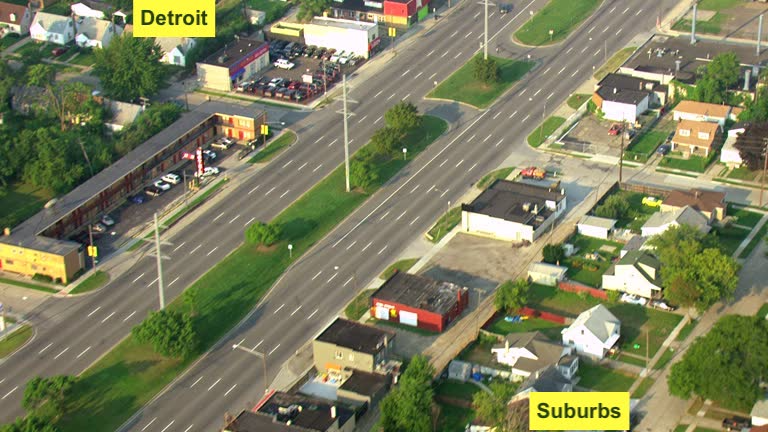
Growing up in Ferndale in the 70’s and 80’s, I lived on the other side among White people. I was warned that the Detroit side was too dangerous for White people. They said that if I were to wander into one of Detroit’s Black neighborhoods, I could get beaten up, robbed, or murdered. I never completely bought into the tales because no one in my family talked about Detroit that way. We drove to downtown, the Detroit Institute of Art, and Belle Isle by way of I-75, but we didn’t go into the neighborhoods, so the myths were never dispelled. Also, Detroit had recently been nicknamed “The Murder City,” so the racist warnings were enough to prevent me from testing it out.

But I did occasionally venture to the other side of the road for a quick trip. When my older brothers, 20 and 23, weren’t around to buy beer for me and my friends, we’d drive past my high school to Eight Mile. The party store1 sat straight across on the other side of the invisible 25-foot barrier. One of us went in, took a 12-pack of Old Milwaukee or Rolling Rock to the thick plexiglass divider, and bought it without a word. Then we’d cross the eight lanes again and go back to Ferndale for a local party, or to my house where there were no adults. My parents divorced in 1974, so my dad was at his apartment most of the time. When he did stop by unexpectedly, he didn’t have the paternal nature to admonish or warn us. And in 1983, during my junior year, my mom died from lung cancer. My brothers and I essentially had an adult-free house we could use for keg parties or play cards or drinking games with our friends. I had a preposterous amount of freedom for a high school kid.
I moved to Seattle when I was 20, unaware that systemic racism had built the invisible racial barrier along Eight Mile. I also didn’t know that similar deliberations were made by Ferndale School District to segregate the Black kids to one school: Ulysses S. Grant Elementary2. I can only remember two Black kids where I spent kindergarten to fourth grade at Jackson Elementary. In third grade, I made friends with Ray Pack, who came over and my mom made us peanut butter and jelly sandwiches with milk. Presumably, Ray was at Jackson because his family bought a house in a nearby White neighborhood. The other kid was Diane, who had a big, bright smile and got around using forearm crutches. She and her family may have lived nearby too, except that she had a serious disability. The Ferndale School District directed all elementary-aged students with disabilities, regardless of color, to my school, so it’s possible that she was bussed there. The Black kids without disabilities were not bussed and instead went to Grant Elementary.
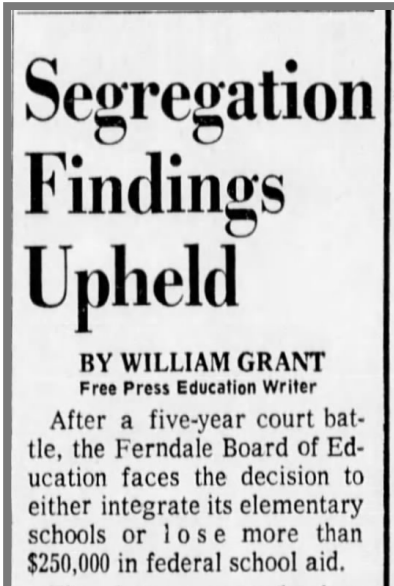
Most of the kids who went to Grant also lived in an all-Black neighborhood called Royal Oak Township, or, the Township, which is within the Ferndale School District. I was in my late 50’s before I discovered that our district was one of the first in the northern half of the U.S. to face state and federal sanctions for violating the 1964 Civil Rights Act because, at the elementary level, they refused to bus Black students to White schools. The State of Michigan began an inquiry in 19673, the School District gave up hundreds of thousands of dollars, and it took fourteen years before it was resolved in 1981, my sophomore year.
It was at Best Junior High that kids from the Township were mixed with White kids. We had the same classes, and many of us played sports together. Despite the history, desegregation for me meant spending six friendly years together which created a lot of memories that still make us smile and reconnect on social media.
When I was a junior, I failed a class for too many unexcused absences, was permanently kicked out of Mr. Grad’s geometry class, and I tortured a meek substitute in Mr. Munson’s psychology class by imitating a tyrannosaurus rex. I was a rambunctious kid in the first place. I responded to my mom’s death by meandering straight to the denial stage of grief, where I stayed for several years. I evaded negative emotions and used my youngest child of five energy to develop my class clown persona. I had almost no fear of consequences because even when my mom was living, her parental enthusiasm had waned from trying to manage my four older siblings for the previous 12 years. My dad didn’t play father, but he was a good friend.
One of my rambunctious moments was partly instigated by a guy in my psychology class who went by the nickname, “Bumpy”. He was about 5 ’10” and could dunk a basketball, which was one of the reasons our basketball games would sell out. Word had spread that he won fights in The Township and in Detroit, so most students were intimidated by him. I only knew him as a good-natured and low-key guy minding his own business, but that reserved side of Bumpy was set aside after a couple of friends pressed me to “do the dinosaur” during class. I had a spontaneous performance in which I’d mimic a T-rex with my hands in front of my body and legs moving in staccato fashion, like the dinosaurs we saw in bad 1970’s stop-action films.
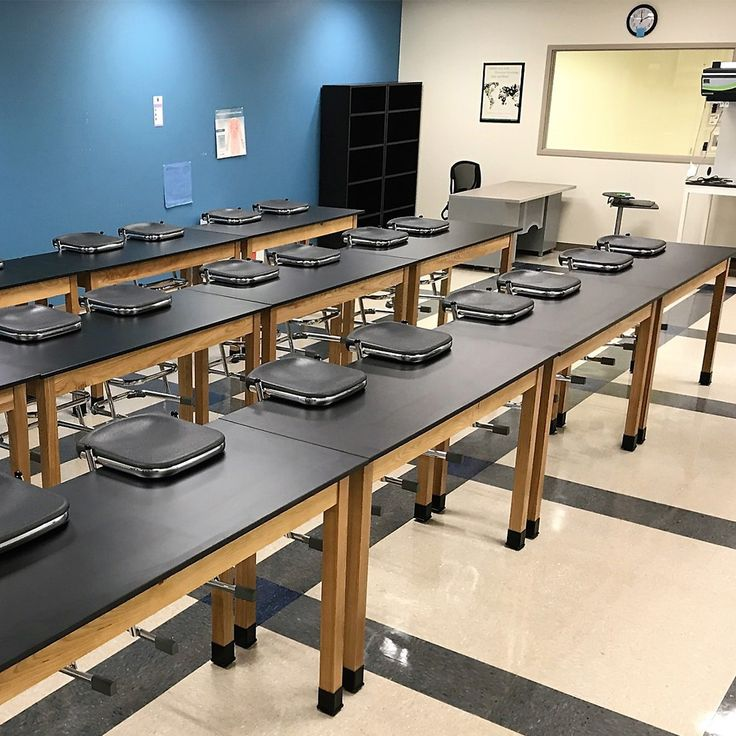
I took the bait and paraded up and down the side and back of the room, screeching as if I were a dinosaur, my head bobbing back and forth like a chicken. Instead of sitting back and watching, Bumpy was out of his seat looking for more. Long and lanky, he pulled a chair up next to the heavy black science lab tables. “Flavin, do it on the tables!” The substitute uttered some sort of disapproval, but I don’t remember waiting for him to do something. In a couple of seconds, I was doing the dinosaur on the tables, which spanned most of the width of the room.
At the front of the room, arms crossed, the substitute shook his head without a smile. Many of the students were out of their seats. Bumpy continued to promote the chaos because doing it on the tables wasn’t enough. “Do it on the heater!” The heater was wide and strudy and ran along at the bottom of the ceiling-high windows. Barely audible, I heard the sub say, “No…don’t.” I hesitated and made eye-contact, but Bumpy was on fire, “C’mon, Flavin, do it on the heater!” Others joined in, “On the heaters!” I hopped from the science tables to the heater, went back and forth a couple times, the class burst open triumphantly, and the sub sat down on the science lab stool, arms still crossed.
That was the climax of the show, so it soon came to its natural end. We settled down, the bell rang, and we all left psychology class smiling and on our way to our respective classes. Probably humiliated, the substitute never reported the event, so no one got in trouble.

Teaching High School
Thirty-five years later, while living in Maryland, I visited Ferndale and ran into a former classmate who I hadn’t seen since high school. He asked the usual question, “So, what do you do?” I told him I was a high school English teacher, and he replied, “You? Seriously? Oh, my god!” I could see a gold filling or two in the back of his mouth when he laughed. It’s an indignant response, but Keith, who has since become a close friend, was being himself: honest with no filter. His response was based on the person he knew in high school. I was the class clown who became a teacher, which was like the high guy becoming a cop.
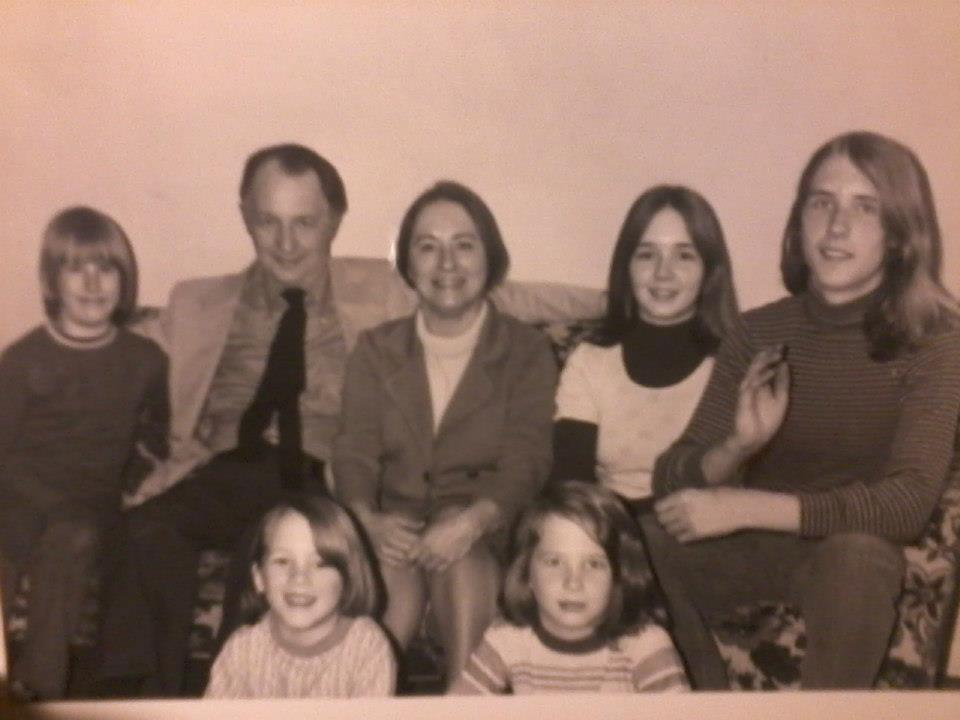
There was a lot that Keith didn’t know about me in our younger years because there was a lot I didn’t know about myself. It took two decades after high school to realize that underneath my so-called carefree teenager veneer, I had a temperament for teaching high school-aged kids. I had fed off the class clown image for so long that it masked the self-awareness one needs to discover more consequential attributes. Being a class clown distracted from my parents divorcing in 1974, my two oldest siblings (15 and 16) fleeing the household that same year, my having been molested, and my mother getting cancer when I was 15 and dying when I was 16. Life was all fine, as long as I didn’t talk about those things. Twenty years after high school and ten years after college, I began my first profession somewhat related to my college degrees.
One similarity of my younger self that carried over is a willingness to bend rules. As a teenager, I skipped classes, cheated on tests, did the dinosaur, and got banished from Mr. Grad’s geometry class for being a horse’s ass. But as an adult, if I want to be an effective teacher, bending the rules is a matter of necessity. In my first year, I looked at the long list of Common Core standards that, according to the Oregon Department of Education, English teachers were expected to drill into students’ heads and thought to myself, “That ain’t happenin’.” From that day forward, my task each year has been to figure out which standards to keep and which to shed to make sure I could be effective and students learn what they truly need.
In my first teaching position, from 2006 to 2018, I taught high school English in a rural school district in Molalla, Oregon. It had around 2,500 students and 300 teachers with one high school. By contrast, I am currently employed by an urban/suburban district in Maryland, which has 110,000 students and over 9,500 teachers with 21 high schools. They are at opposite ends of the spectrum. One is small and approachable, and the other is unwieldy and rife with politics. Holding two divergent positions in the same profession has given me a unique perspective on education in America. The most apparent difference is that one of them is nimbler.
As a teacher, bending the rules means that I modify state or district expectations so I can accommodate the students in front of me. At the middle and high school levels, all teachers do some version of this because we’re given 10 units of curriculum and 7 units of time, depending on the district. The larger the school district is, the more detached they are from the daily experience in the classroom, and therefore, the more likely they are to expect more material to be covered. The smaller the district, the more likely it is that teachers can have lunch with the principal, or walk over to the district office and request a sit-down with the superintendent. A teacher can have conversations with administrators and personally discuss the most salient question of all: What’s best for kids?
In Oregon, teachers collaborated with their administration on the grading system, classroom culture, and school policies. We wrote our own curriculum, workshopped common objectives as a staff, and knew everyone’s names. We didn’t always love each other and there were rifts to resolve, but teachers had agency and autonomy so that we could create lessons that transmitted the same to our students. That’s nimble.
My current district in Maryland paid for a pre-packaged set of educational materials and lesson plans for the English department. We don’t write the assessments, create the rubrics by which to assess them, choose the required reading, or how the materials relate (if at all) to the rest of the purchased curriculum. I might collaborate with someone from another department once or twice a year. We’ve made no investment and have little ownership, and that disempowerment is transmitted to our students. To get around the blanket administrative expectations, I bend the rules and modify the district’s demands.
What’s best for kids is not different from what’s best for adults. Like adults, children want to be respected. They want their dignity. They need purpose and agency to feel motivated. They don’t thrive in an environment that is physically inactive, informationally repetitive, routinely predictable, and stifling. Certainly not people in the adolescence stage of development whose curious minds are built for discovering their identity and where they fit into the world.
Professor of Education and Psychology Erika Patall at the University of Southern California studies motivation in learners. She writes that over the last two decades, research highlighted the “importance of the learning environment in supporting the educational process.”
At 15 years old, a child has been contemplating adulthood for about three or four years. No nine-year-old ponders the relationship between their schoolwork and a career path. I doubt very many 10-year-olds do, and depending on the daily involvement or absence of their parents, it may not be until they sit down in my 10th grade classroom before they finally hear someone articulate the connection: “Ignoring your schoolwork, skipping classes, and getting suspended leads to a crappy job and a difficult adulthood.” By this measurement, high school students are one to five years old when we ask them to understand the gravity of their decisions. In this context, what we ask them to do and how we ask them to do it is paramount, and learning 10 units of marginally relevant curriculum while sitting and listening for 30 hours a week is not the best we can do for kids.
When my students are working on something, and I ask, “Who wants to run out to my car for something?” Hands shoot up. “Me!” They are desperate for movement, for a job to do, for something different than the usual. Anything. Sometimes I’ll send two kids for a one-person job. They like to be trusted with my keys and personal space.
I’ll ask, “Who wants an administrative job?”
More hands shoot up, “I do!” And then, “Wait, what’s that mean?”
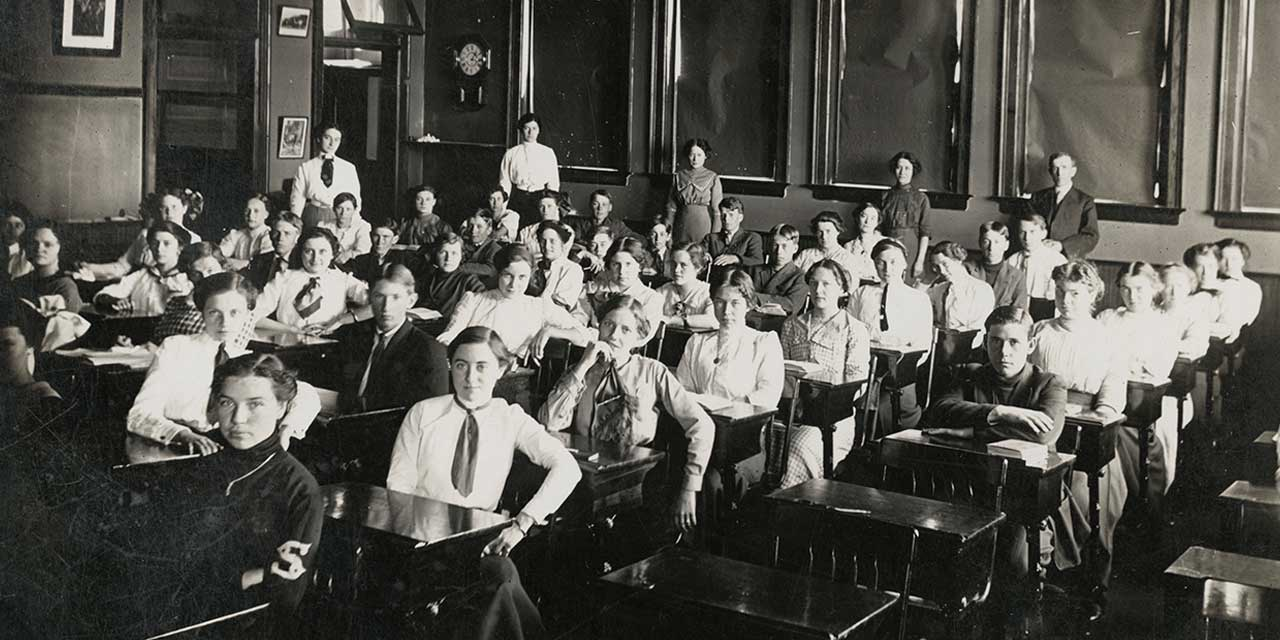
The structure of the school day in 2025 is untenable. Maybe it fit into the industrial ethos a century ago when compulsory American education was being developed and mental illness was resolved by performing frontal lobotomies, but sitting still and quiet in seats every school day has never been the answer. It wasn’t for me or Bumpy in 1983 any more than it was for adolescents 50 years before that, and least of all, today. We still teach as many kids as possible using as few resources as possible by creating the conditions that serve the financial bottom line at the expense of child dignity.
The world has changed, children have changed, needs have changed, and the factory model4 is ill-conceived for educating youth. Former Secretary of Education under Obama, Arne Duncan, said it in 2010:
“The factory model of education is the wrong model for the 21st century. Today, our schools must prepare all students for college and careers—and do far more to personalize instruction.”
Public education, beginning at the state-level, could provide healthy breakfasts, not bags filled with different manifestations of sugar. We could transform the curriculum to provide courses that high schoolers will need, like lessons on owning a car vs. public transit, credit, insurance, and retirement. We could get them out of their seats, using their hands, visiting workplaces, and interacting to get what they want or need. We could change its structure to include smaller, subject-focused schools, and provide different career opportunities for kids who know what they want to do, whether it’s skilled labor, education, business or medicine5.
Imagine a small, four-story building filled with 450 students interested in becoming doctors, nurses, veterinarians, dental assistants, or athletic trainers. Imagine a school in the same neighborhood with 550 students who have the same opportunities and requirements, but it revolves around all things business; entrepreneurship, marketing, sales, pricing, profitability, inventory, and supply chains. Imagine the original school with 1,000 students instead of 2,000, with space to breathe and room to think. It might be a general education school with enhanced vocational opportunities, engineering, plumbing, culinary arts, cosmetology or interior design.
Everyone still learns history, science, health, reading, writing, and has access to physical games and challenges. They could spend afternoons volunteering, interning, or on-site doing the work with their hands and on their feet.
Kids who are engaged in curriculum that empowers them to direct their own futures don’t “do the dinosaur” on school heaters. They don’t sleep through classes if they’re busy shadowing a nurse at a local hospital. When their day has purpose, autonomy, agency, and voice, they’re less likely to jeopardize their own path in life by fighting, skipping or getting high. They always have and always will be adolescents who make poor decisions, but far more will make healthy ones if each day their dignity is honored.
American education has become an institution that, more than ever, constructs and reinforces positive cultural norms, holds students accountable for negative behavior, counsels them on pathways to adulthood, acts as mentors and role models, provides emotional support, fosters social skills, nurtures talents, manages crises, builds relationships, and connects families to community resources. Out of their own sense of responsibility or empathy, teachers have always done what they could to help children beyond the instruction of their subject matter, but 120 years ago, the only legal obligation was to teach the ABC’s and sharpen rote memory.
In the same way that the Civil Rights Act of 1964 required the Ferndale School District to desegregate, districts are required to provide a “free and appropriate”6 education for every child. It has cost a lot of money to require districts to bus children to schools outside of their neighborhoods, but it was the right thing to do, so we paid for it. It also cost a lot of money when laws changed in favor of students’ well-being. “Free” means free, but only in the last 20 or 30 years, has “appropriate” represented meaningful change. Now, educators understand dozens and dozens of medical, psychological, social, cultural, and economic variables in order to teach, say, history or Spanish.
The reason its changed is because countless students in public education, born and raised before or after the advent of the Information Age, live in unstable households with struggling parents, live with disabilities, and lack the money to make the best of this antiquated structure so they can attend higher education. As Denise Pope, senior lecturer at the Stanford University School of Education, says in a 2025 New York Times article: “We’re not aligning the developmental needs of kids with the policies and practices that go on daily with schools.”
We have improved education by passing laws that help to guarantee the appropriate education, and yet the structure of our schools and the school day remains unchanged.
My students seek dignity. Bumpy sought dignity. I sought it, but when I ignored the substitute’s dignity, it was because I lacked it. I lacked parental guidance and faced my own host of personal obstacles. There must be dignity in what we do before we can have the motivation to do it. If I force 10 units of curriculum into my students’ 7 units of time, apathy swells and motivation disappears. Most of the children who walk through my classroom door are hauling dark histories or practical barriers, enduring social biases or medical impediments. Bending the rules to honor their dignity is a matter of empathy and efficacy, but providing poor quality food, shelling them with standardized assessments on arbitrary topics, forcing silence and stillness, and cramming 2,000 students in a building best suited for 1,500 (or less) are not institutional acts that signal respect to young people. There are ten-thousand and one ways to signal respect, and since the need for respect is universal, it should be in the bones, flesh, and blood of public education.
Around 3.2 to 3.8 million educators work in U.S. public schools, and 99% of them started because they wanted to help young people learn and grow. It can be an exhausting profession, so 44 percent quit within their first five years of teaching. Why is it so exhausting? Is it because teaching is innately difficult? Sure, but can we expect the century-old system to serve the dignity of teachers any better than it serves students?
What happens when millions of teachers continue to labor in this taxing position beyond five years? Millions of unhappy teachers lose their eagerness to manage a room full of children, let along nurture their desire to learn and grow.
Let me rephrase: The purpose of education is to nurture our young people’s desire to learn and grow. Every teacher, even those who are hanging around too long and those who moved on to new professions, agrees that every child deserves to be nurtured and given the opportunity to learn and grow.
By hanging on to the current structures with the Industrial Age ethos long gone and the Technology Age foisted upon us without a manual, American public education begs for a complete revision in the way it functions, and more importantly, the way that educators and students function within it.
The factory model is a relic of our undemocratic past, when women couldn’t vote, children labored for 12 hours a day, those with disabilities lived solitary lives among family (or perished), and people of color were systemically and openly oppressed. The origin of our public schools comes from good intentions–to educate–but it has always been about creating a system that adults think kids need, and the ideology that, when they succeed, they will earn their dignity.
I contend that it’s the other way around: Make dignity the lens, the guide, and the goal of our public-school systems, and success will follow.
Notes
1 – In Michigan, we called convenience stores “party stores.”
2 – For more on segregation in Ferndale, go to Ferndale Schools.
3 – For more on Michigan State and the U.S suing the Ferndale School District, go to Ferndale Gets Sued.
4 – For more on the factory model of education, go to Factory Model.
5 – Alternative public education models in Europe use diverse approaches like Montessori & Dalton schools (individualized learning in the Netherlands), Waldorf schools (holistic, anthroposophy-based), Forest Schools (nature-based, self-directed), Charter/Free Schools (publicly funded with pedagogical freedom, common in Nordic countries), and experimental models focusing on diversity, multiculturalism, and vocational links (like in Hungary/Romania), all promoting student autonomy, experiential learning, and tailored paths beyond rigid curricula. For more: Non-factory models of education.
6 – For more on a free and appropriate education: A Free Appropriate Public Education is a U.S. federal right for students with disabilities, guaranteed by laws like IDEA and Section 504, ensuring they receive specially designed instruction and related services at public expense to meet their unique needs, often through an IEP, in the least restrictive environment (LRE).
7 – For more on the mental illness crisis among adolescence, go to Johns Hopkins Children’s Center.
Addendum:
A Little Story and Some Student Art
“If You’re Jessie”
If you’re Jessie, a skinny 15-year-old girl, five feet two inches tall, a little acne, plainly clothed, and you wake up each day with your parent or guardian skulking around the apartment in her pajamas until you walk out the door and into the dark neighborhood without food in your belly because you couldn’t bear to hear another minute of her complaining…
If you get on a crowded yellow bus because you’re at the end of the bus route, and arrive at school, you join 2,000 other kids, many of whom have real confidence and strong personalities, or at least a persuasive bravado of which you can’t tell the difference, and you’re vying for space in narrow hallways, getting bounced by 150-pound senior girls with bodies that seem strong enough to carry a piano across a baseball field…
If you get to class and the teacher talks for 45 minutes about something he’s never given anyone any reason to care about, and then offers the last 20 minutes to complete a reading and a worksheet that takes 45 minutes to complete…
And if the bell rings while you’re doing your work, you unconsciously stand up like a hamster that hears someone fussing with its food container, and you remember that again you are about to enter those crowded hallways full of competitive walking and talking and noise and the smell of pot in some kid’s backpack…
And you are smart…
And you want to do well in school…
And you want to graduate…
And even though you’re unsure of the difference, architecture and interior design are on your short list of possible directions to take in life…
And if this transient dream is disrupted when you remember that the next class continues the daily routine, which demands another 20 minutes of homework that adds to your after-school schedule of chores and taking care of the little one while mom works…
If the next day presents the same feelings of powerlessness, except that the next day is better because there are four classes on A day and four on B day, and on B day you have Mrs. Grady and Mr. Sears, and they are like an oasis in the desert of information overload since they smile a lot and notice you and have interesting activities and don’t try to fit 10 units of school work into your 7 units of time, a problem that not all teachers know how to resolve because they are compelled to do what the State mandates and what the District orders, and they fulfill no fewer than 8 units of work…
If you are Jessie and the bright spots on B days are quickly forgotten because two classmates are flirting but you’re socially inept and can’t imagine how they can be so carefree, and you’re tired because you were up late, worrying, and there are three boys sitting at a table-group who you wish to God would shut the fuck up, but the teacher never separates them. Then you feel a little guilty for swearing in your head and genuinely feeling it, because if you are Jessie, you’re still trying to figure out what you can and can’t think, what you should or shouldn’t say.
More Student Art and Poetry
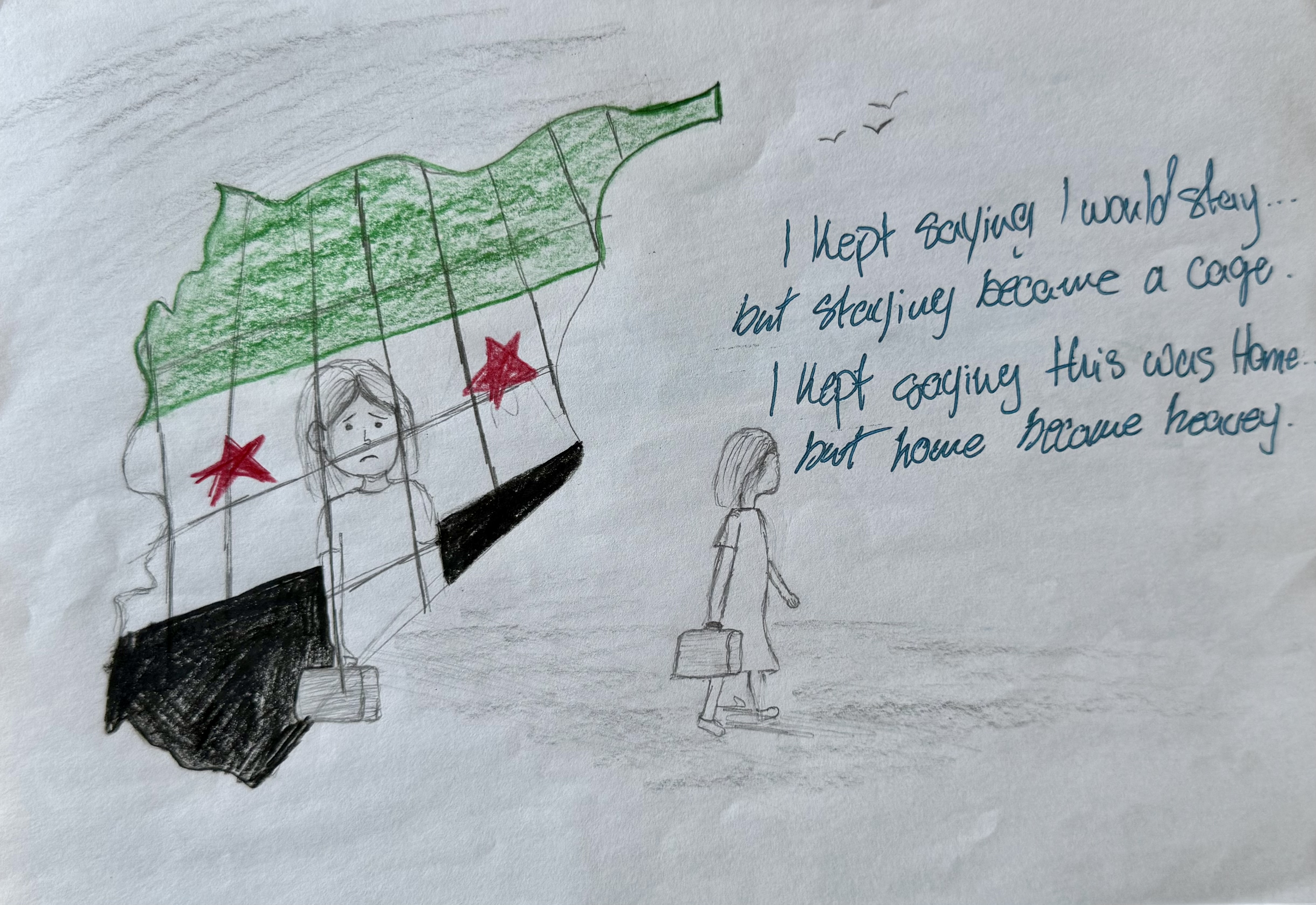
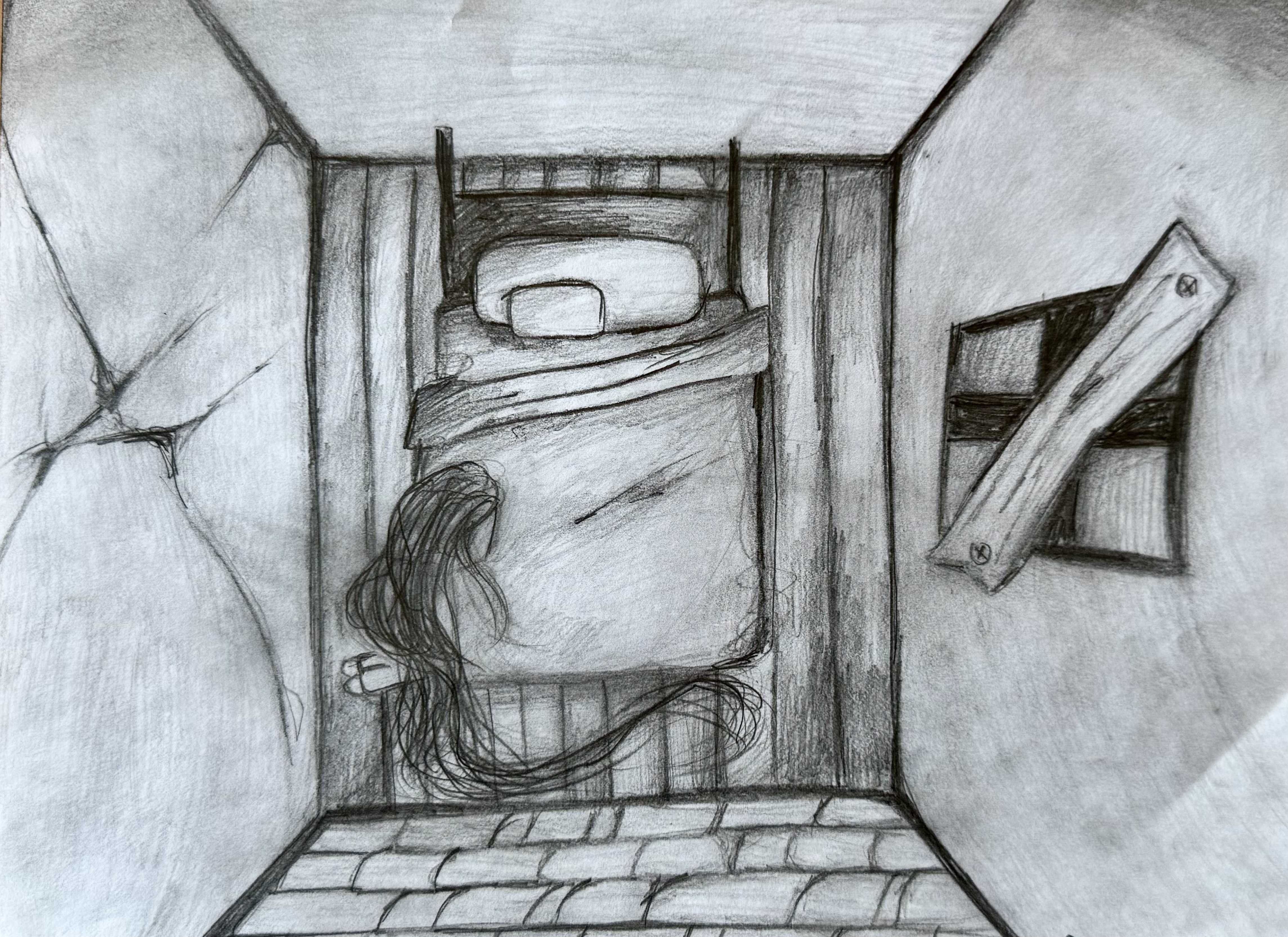
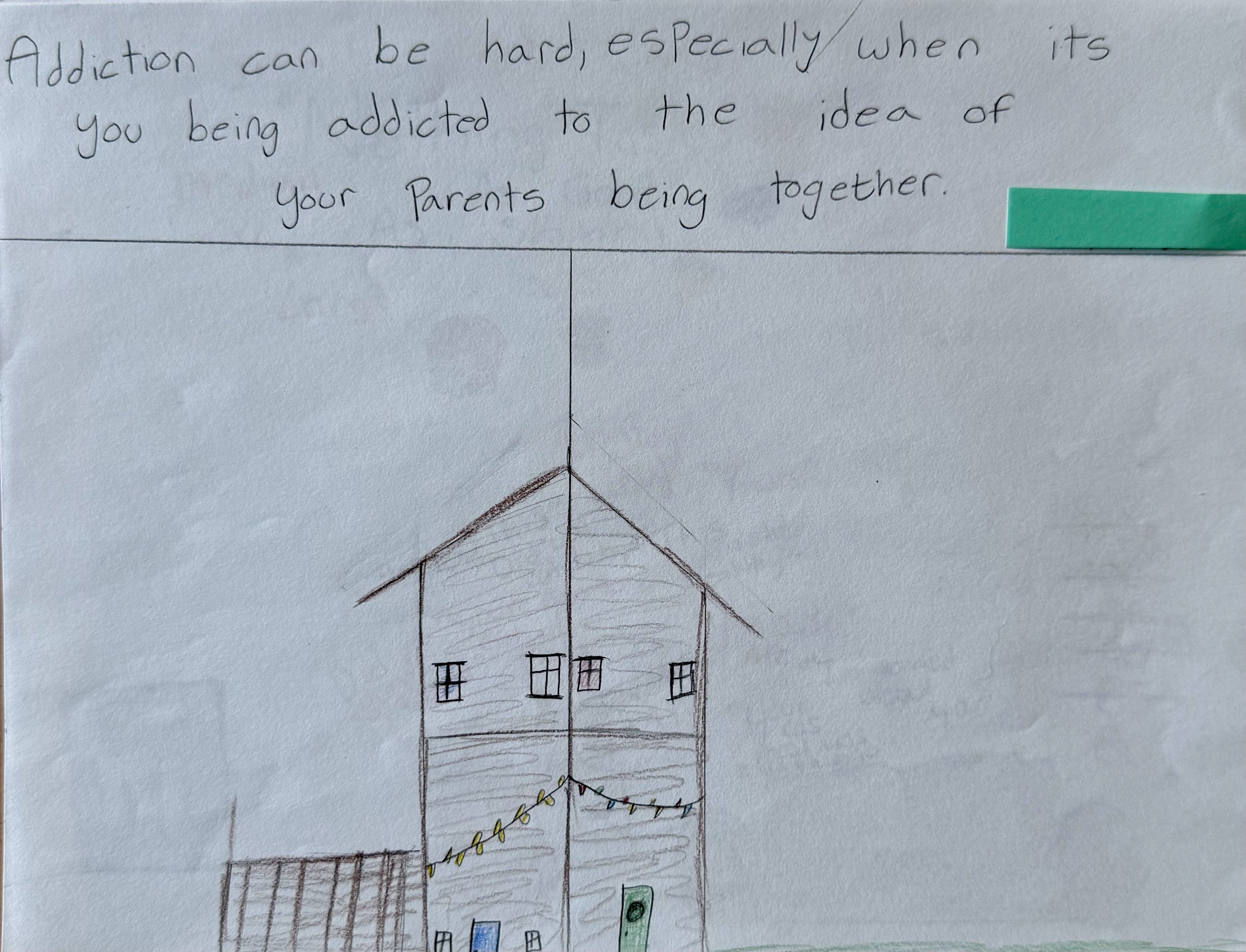
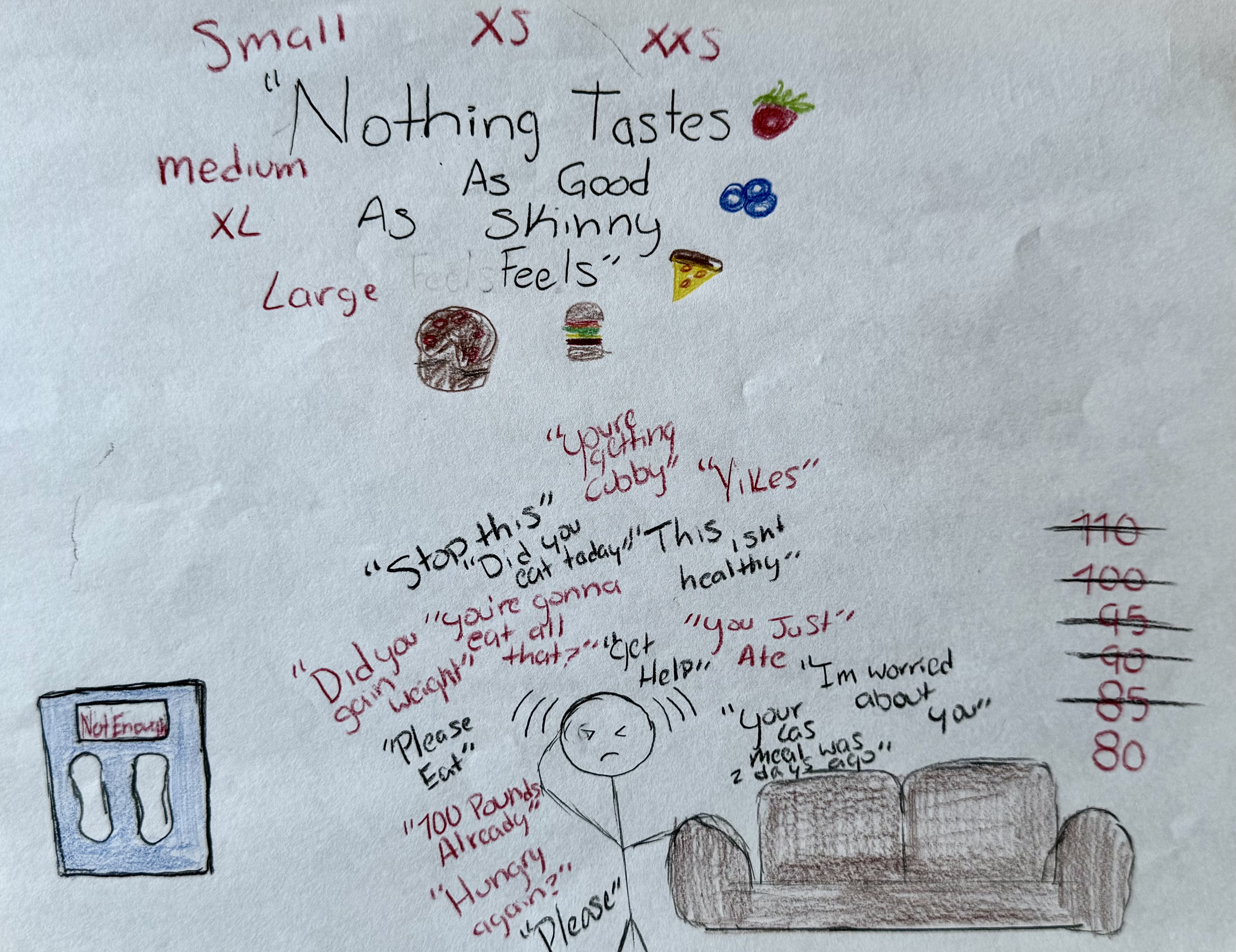
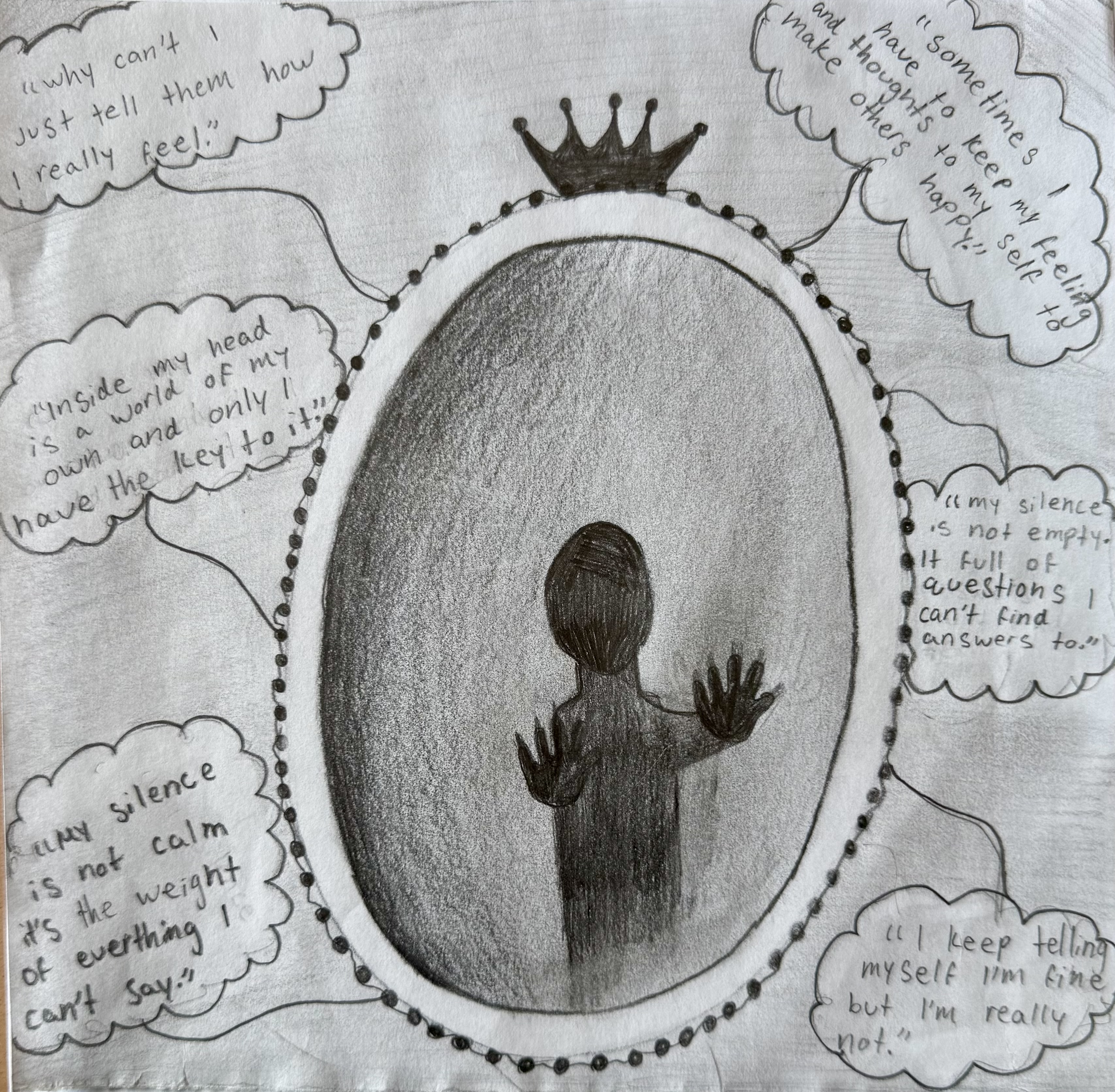
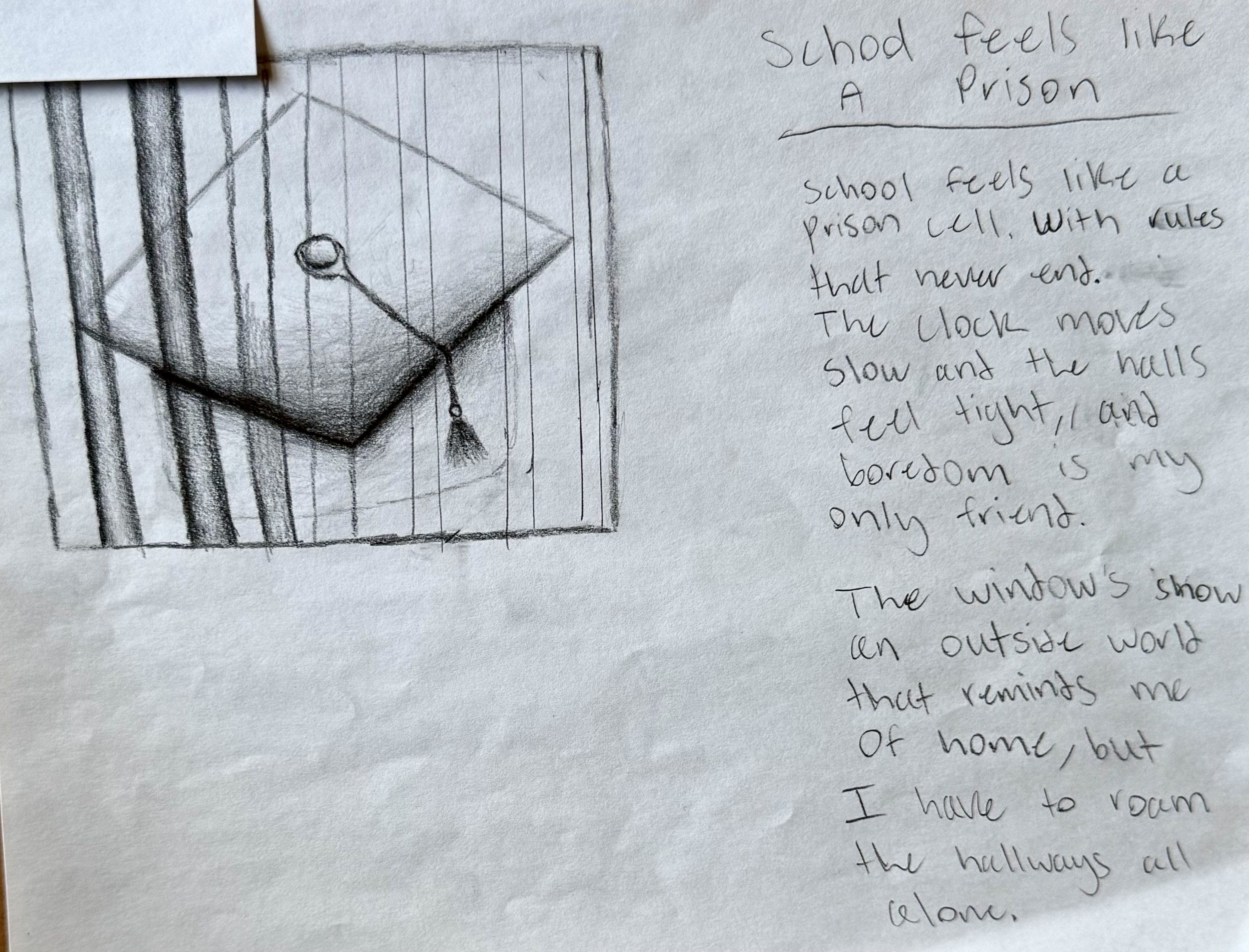
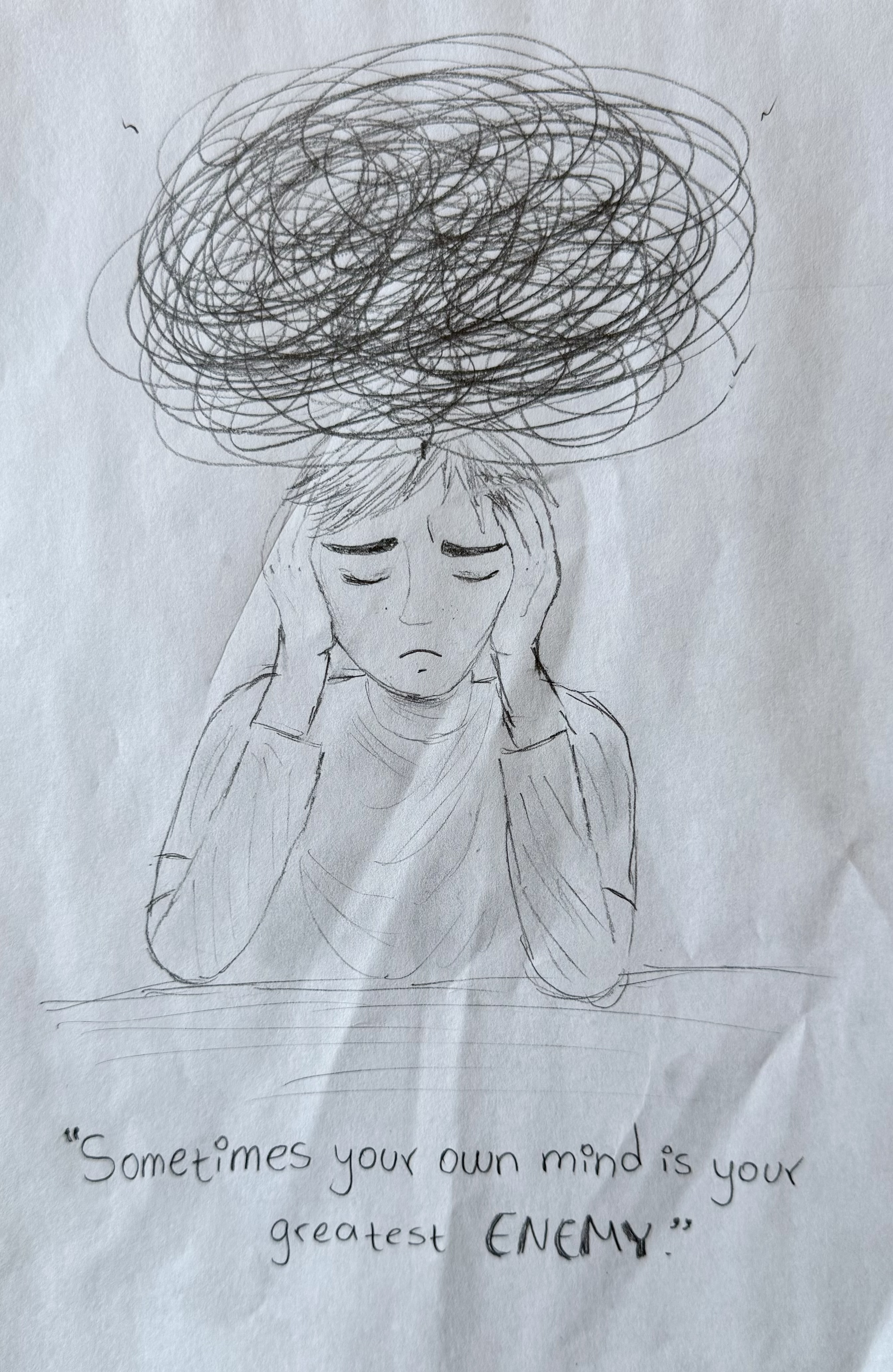
In the middle of the second quarter, the Grade 10 Team of our English Department at my high school created an assessment during our unit on the Holocaust. We read Night and explored seminal works that discuss freedom, such as Franklin D. Roosevelt’s “Four Freedoms” speech, as well as freedom from oppression, such as Maya Angelou’s poem, “I Know Why the Caged Bird Sings.”
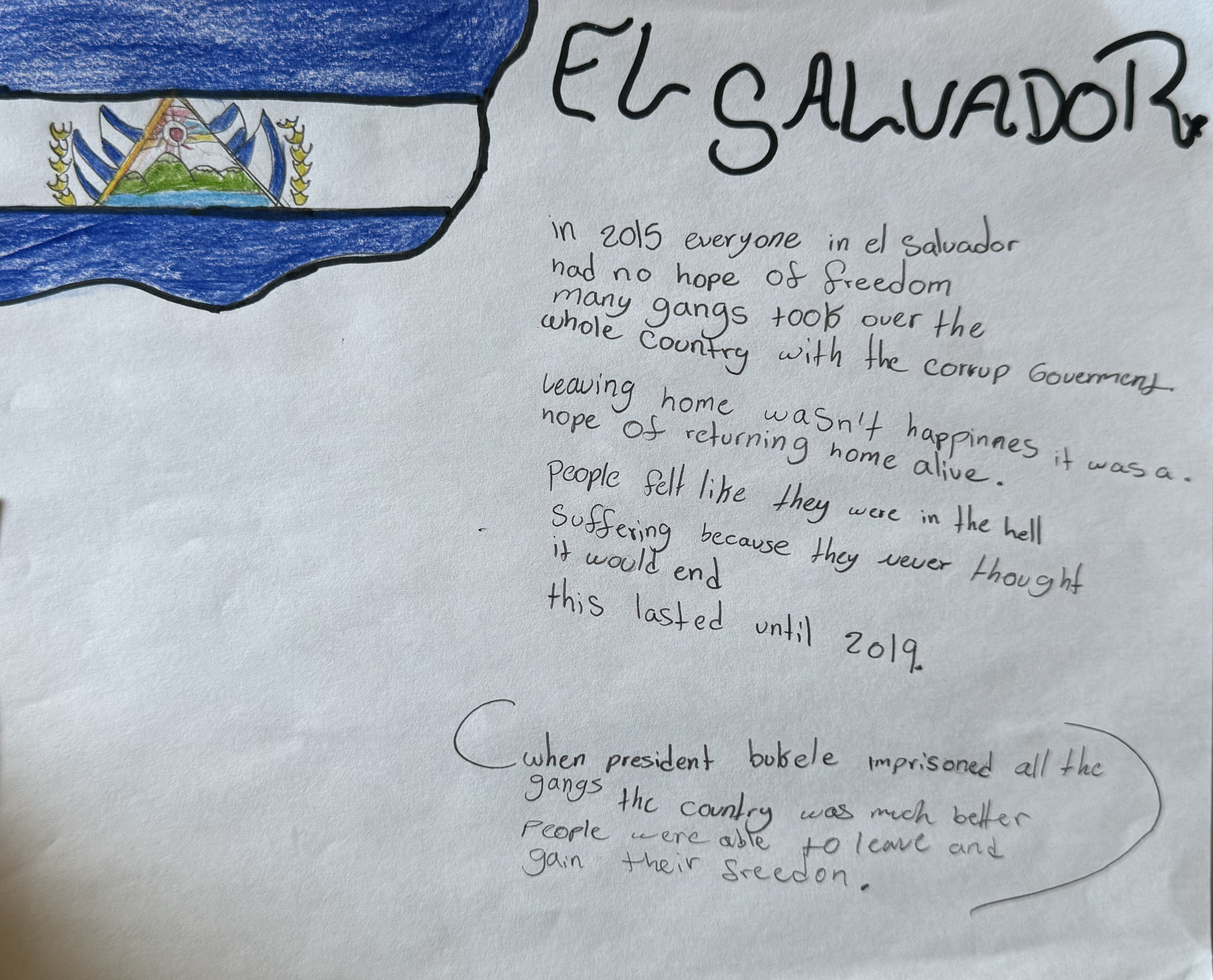
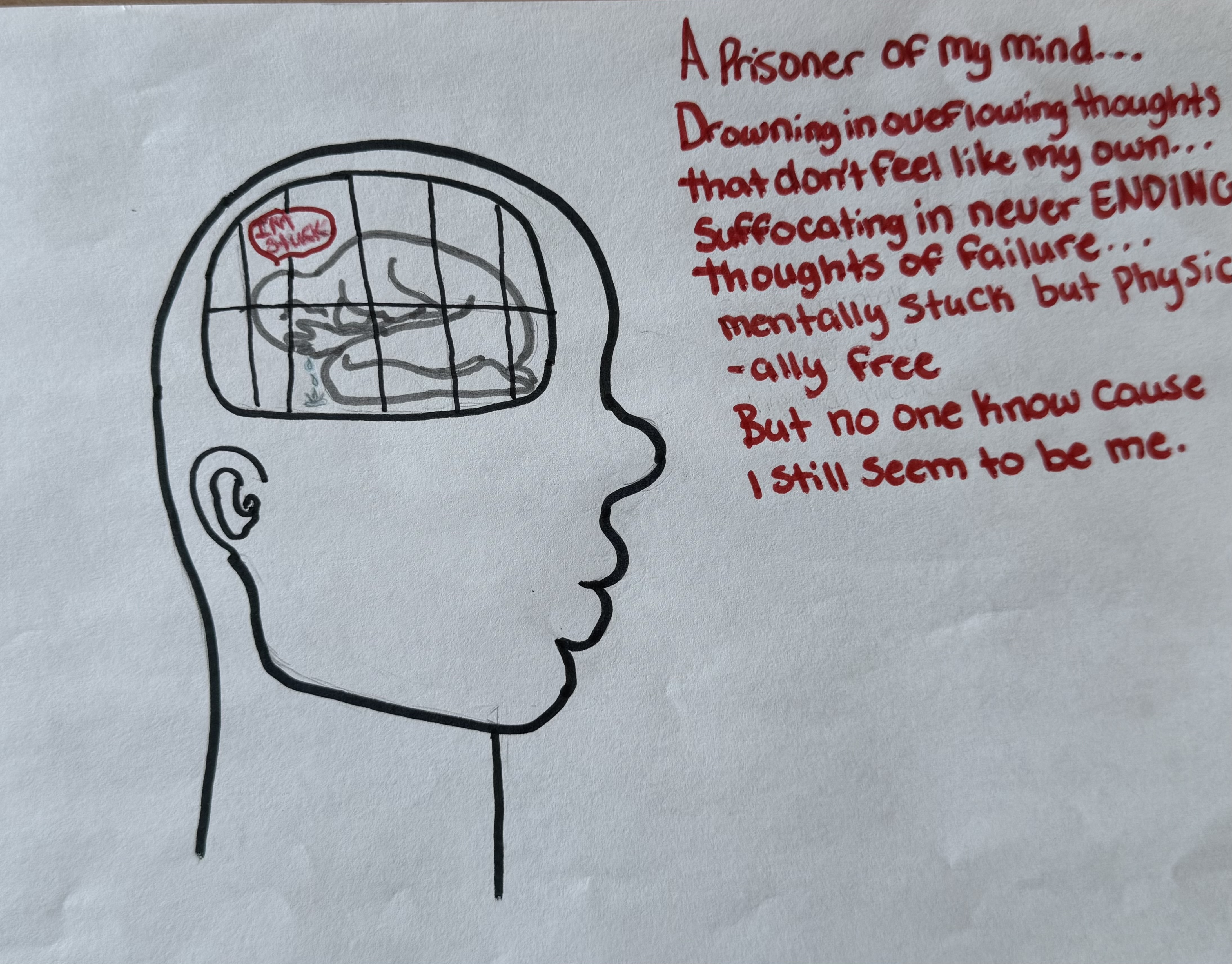
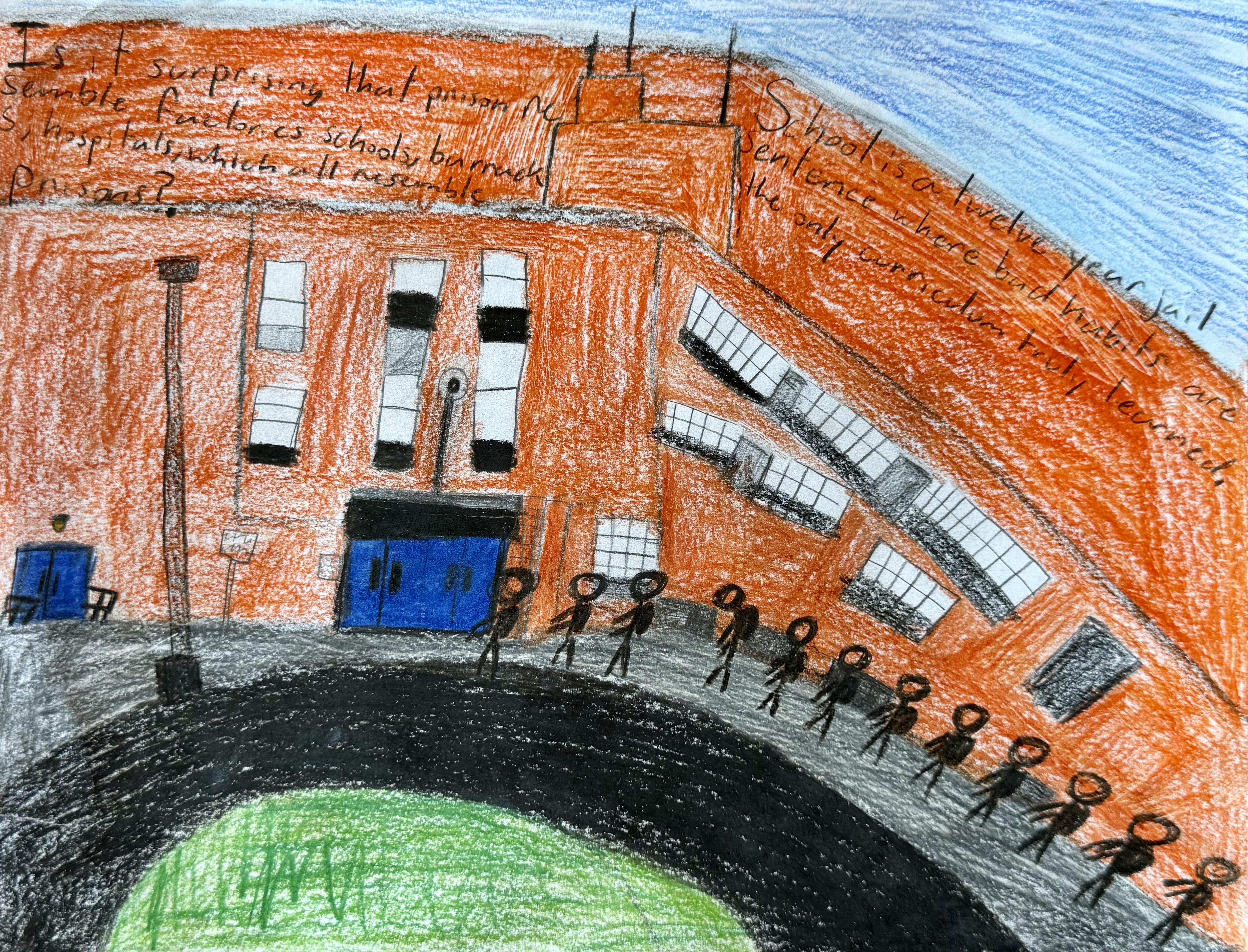
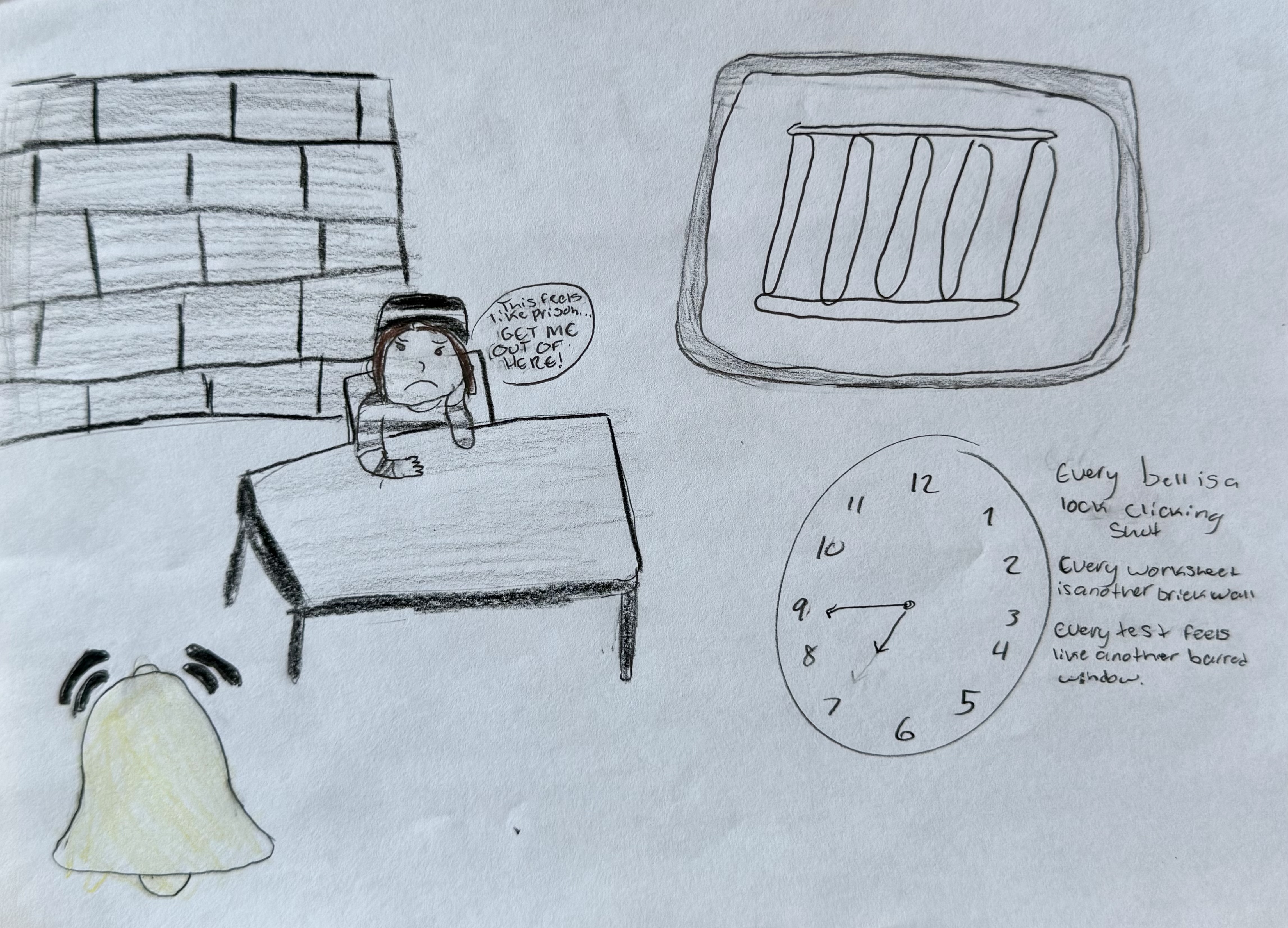
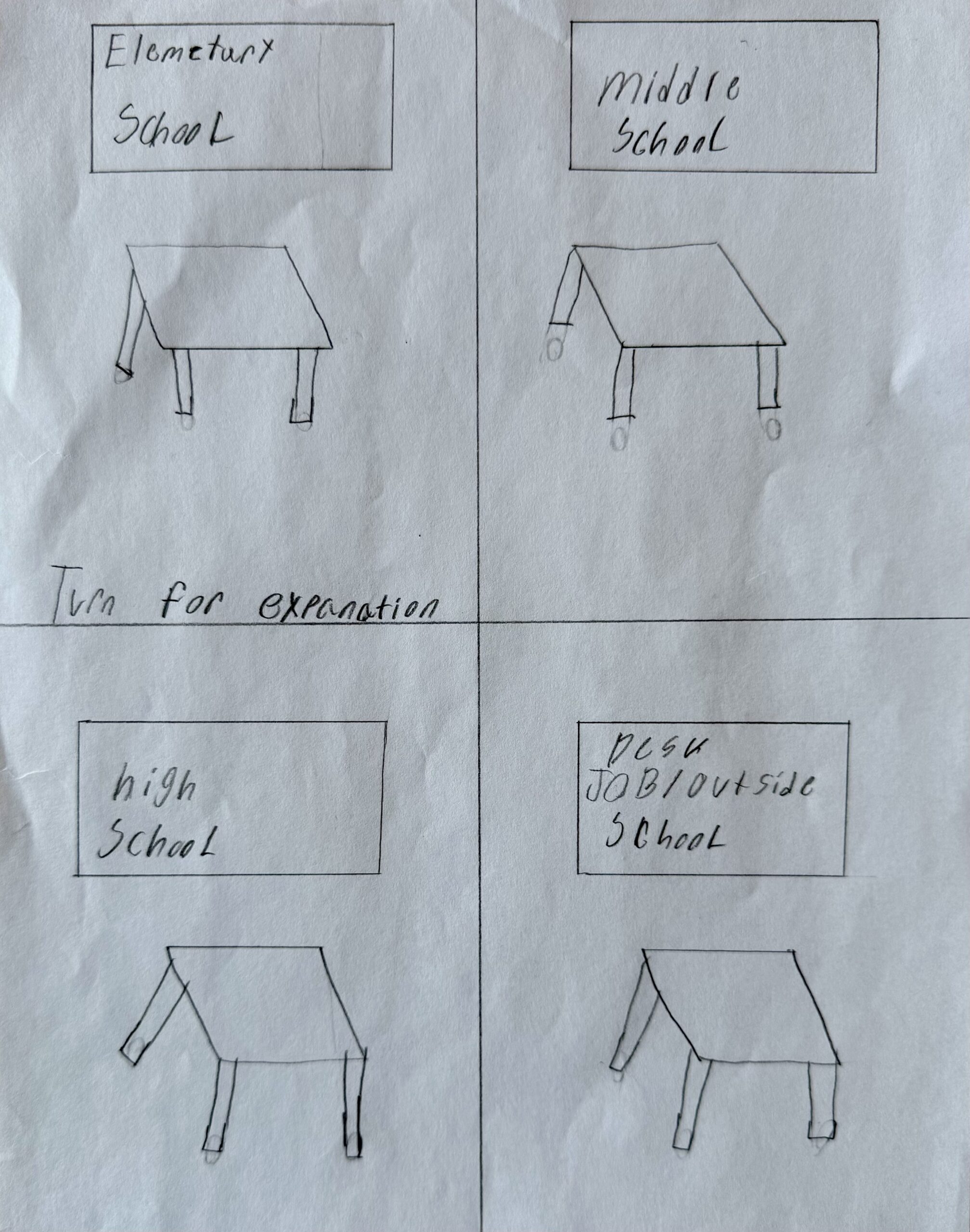
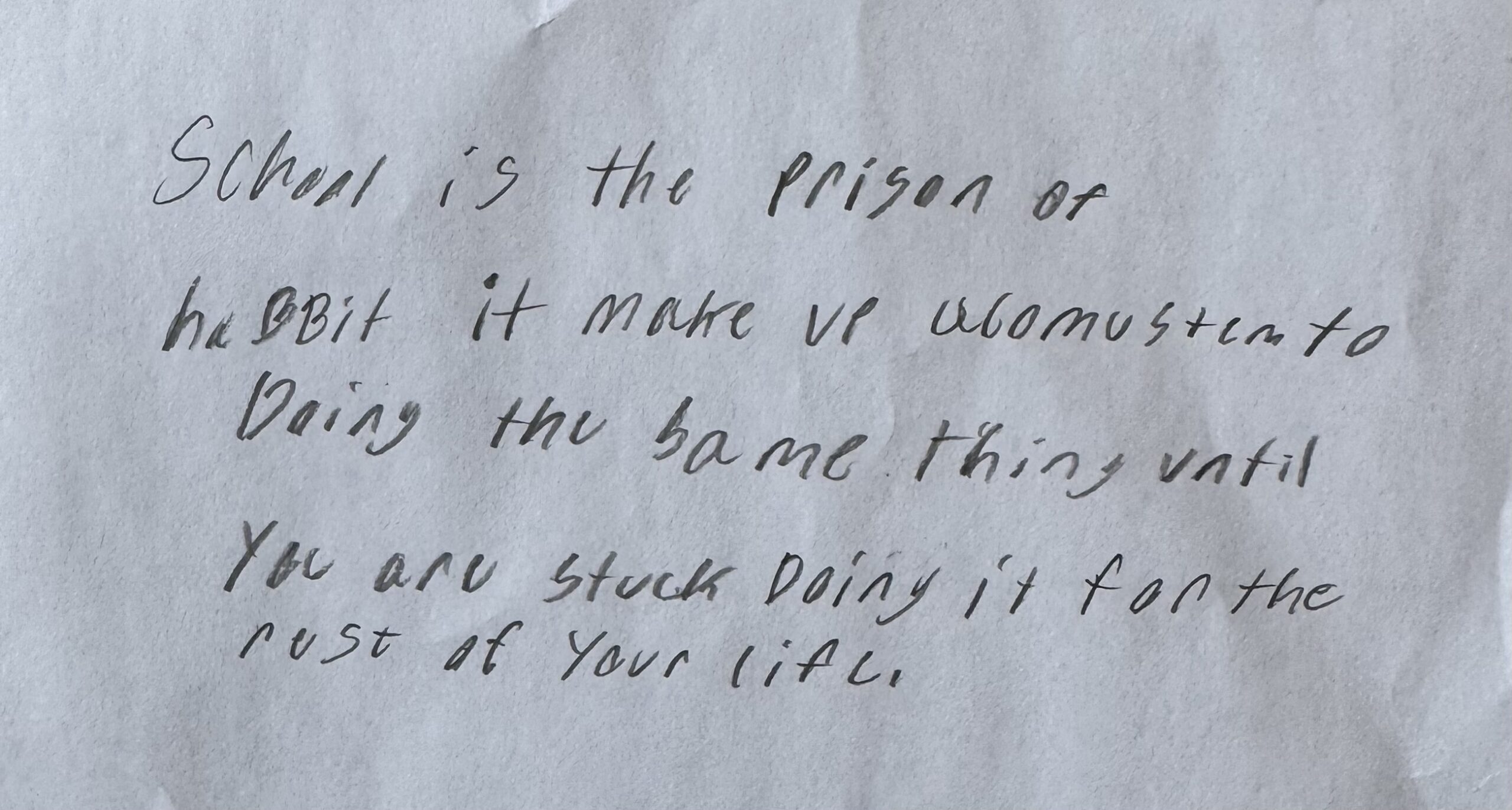
In the student work below, their assignment was to create any piece of art or writing in any form that expresses a metaphor for a prison they experience in their lives. They range from immigrants who are in America as refugees to students coping with mental illness.